focus / field
Speak where you already work.
Hold a hotkey or tap the phone control. Voca listens, transcribes, and puts the words where your cursor is when the platform supports it.
the words go where you are already working
private speech-to-text, across the machines you own
Voca is a family of free and open-source speech-to-text apps for desktop and phone. Speak into the field already in front of you, keep the model close, and choose the path that fits your hardware.
on-device firstgateway optionalopen source
the same promise, wherever you work
Voca keeps the gesture simple and the boundary visible: speak, choose where the speech-to-text model runs, and get text back in the place you were already typing.
focus / field
Hold a hotkey or tap the phone control. Voca listens, transcribes, and puts the words where your cursor is when the platform supports it.
the words go where you are already working
model / path
On-device mode is the simplest path: download a speech-to-text model and process there. If you want shared or larger compute, connect to a VocaGateway you run yourself.
model + audio stay here
self-hosted shared compute
boundary / trust
No required Voca account. Open-source code. Honest status labels. When audio moves to a configured gateway, the page tells you exactly where it goes.
the family directory
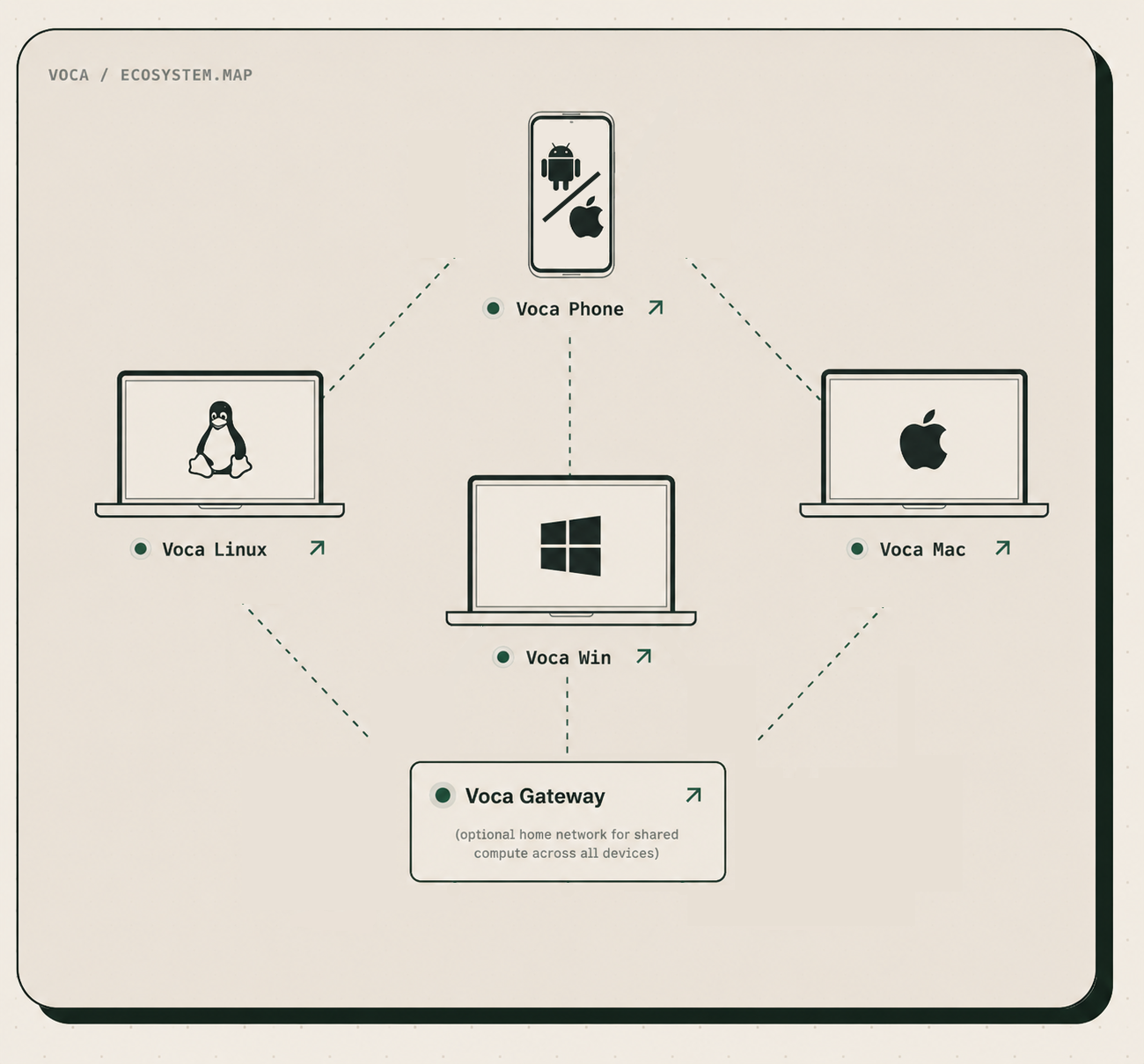
Pick the surface you use today. Each card tells you what is actually available, what it runs on, and where to go next.
System-wide voice typing for real Linux desktops. Choose whisper.cpp, Whisper, or VOSK on X11 or Wayland.
runs on Linux · X11 + Wayland · AGPL-3.0
A native menu bar app for Apple Silicon Macs. Hold a hotkey, speak, and text appears at the cursor through WhisperKit.
macOS 14+ · Apple Silicon · Homebrew or DMG · AGPL-3.0
A private voice keyboard for phones. Android has public beta releases; iPhone is a public TestFlight beta capped at 1,000 seats, or build from source for iOS 17+.
Android 13+ beta · iOS 17+ TestFlight (1,000 seats) or source build · gateway optional · AGPL-3.0
Unsigned Windows beta. SmartScreen will warn because the publisher is not signed. Download it, try it, and file issues.
latest tagged v0.1.1-beta · unsigned NSIS · not a signed shipping build · AGPL-3.0-or-later
Self-hosted shared compute for Voca clients. Run it on a Mac, Linux machine, or Linux container, pair with a QR code, and keep control of the host.
tagged try v0.1.0 · native macOS or Linux · Docker Compose on Linux amd64/arm64 · no packaged installer · AGPL-3.0
on-device or your gateway · you choose the hardware
VocaGateway is optional infrastructure for shared or larger compute. It is self-hosted, not a Voca cloud. Pair it with a QR code, run it on a trusted machine, and keep the network boundary explicit.
Explore VocaGatewayAfter the model download, audio and speech-to-text processing stay on the phone or computer.
Your client sends audio to the gateway you configured. It runs a local engine and returns the transcript.
Gateway mode is not on-device: configured audio leaves the client for your self-hosted gateway. Use a trusted LAN, an encrypted private network, or HTTPS.
the manifesto
There is rigor underneath the playful paper and window chrome.
On-device speech-to-text is the primary path.
Read the code and the license for each project.
The point is the focused field, not another dashboard.
Your Voca setup should not need a Voca login.
Developer alpha, beta, source build, coming soon, and early mean different things.
Issues, pull requests, and contributions are welcome.
where this is going
Follow the repositories for live progress. We do not put dates on work that has not been committed.
a precise privacy promise
On-device mode: after the model is downloaded, the speech-to-text model and audio processing remain on the phone or computer.
Gateway mode: when you deliberately configure a VocaGateway, audio leaves the client for the self-hosted machine you chose. Use a trusted LAN, encrypted private network, or HTTPS.
no required Voca account · open source · explicit network boundary
questions, answered plainly
In on-device mode, yes: after the model download, processing remains on the phone or computer. If you choose gateway mode, configured audio travels to your self-hosted VocaGateway instead.
No. The gateway is optional. Use it when you want shared hardware, larger models, or one self-hosted service for multiple clients.
Choose VocaLinux for Linux, VocaMac for an Apple Silicon Mac, VocaPhone for Android or iPhone via TestFlight, and VocaWin on Windows if you want to try the unsigned beta.
The desktop apps are designed for system-wide text insertion, and the phone apps work through their keyboard or containing app flows. Secure fields, permissions, and platform rules can limit insertion.
Yes, the Voca projects are free and open source. Licenses are named per project in the repository and in the product directory above.
VocaLinux has a current release, VocaMac has a beta release path, and VocaPhone has public Android beta releases plus a public iOS TestFlight beta capped at 1,000 seats, with a source-build path beyond that. VocaWin has an unsigned beta, not a signed shipping build. VocaGateway is beta self-hosted infrastructure.
Join the Discord, read the project source, open an issue, improve documentation, or send a pull request through the VocaHQ GitHub organization.
come build the family
Choose a platform, read the source, report what you find, and help make private speech-to-text feel ordinary everywhere. Discord is the fastest feedback loop if you want to build this with us.